

PEO vs. Payroll Service: What’s the Difference?
Some companies process payroll and taxes, while others can also support HR, workers’ compensation, employee benefits, and compliance.

Payroll might be the task that first sends a business owner looking for outside help. But once you start comparing providers, the options can blur together quickly.
Some companies process payroll and taxes, while others can also support HR, workers’ compensation, employee benefits, and compliance.
That is the central difference between a PEO and a payroll service. A payroll company manages specific payroll-related tasks, while a professional employer organization provides a broader employment solution through a co-employment relationship. The right choice depends on how much support your business needs and how involved you want a provider to be.
What Is a Payroll Service?
A payroll service helps a business calculate employee wages, process payments, withhold taxes, prepare payroll reports, and handle certain tax filings. Depending on the provider, the service may also include direct deposit, time tracking, employee portals, or other payroll tools.
Your company remains the employer and continues managing its own HR decisions, employee benefits, workers’ compensation, workplace policies, and compliance responsibilities.
For a business that already has these areas under control, payroll service can remove a time-consuming administrative task without changing the overall employment structure.
A payroll service processes payroll and related tax responsibilities, but the business remains responsible for the rest of its workforce administration.
What Is a PEO?
A professional employer organization, or PEO, provides payroll services as part of a larger employment arrangement. When a business partners with a PEO, the two enter a co-employment relationship and divide certain employer responsibilities.
The business still runs its daily operations. It decides whom to hire, sets employee schedules, manages performance, determines compensation, and directs the work being performed. The PEO takes responsibility for the employment functions outlined in the agreement, which may include payroll processing, payroll tax administration, workers’ compensation, employee benefits, HR support, and compliance assistance.
PEOs are also commonly called employee leasing companies, although the arrangement does not mean the PEO supplies or controls the business’s employees. According to the IRS, a PEO may perform certain employment tax responsibilities for its clients under a service agreement.
A PEO combines payroll with broader HR and workforce support through a co-employment arrangement.
What Is the Main Difference Between a PEO and a Payroll Company?
The biggest difference is the scope of the relationship.
A payroll provider is hired to perform a particular administrative function. It processes payroll, calculates deductions, supports tax filings, and completes other services included in the contract.
A PEO becomes a co-employer for designated administrative purposes. That structure allows it to support several connected areas of employment, rather than treating payroll as a stand-alone task.
Here is a simple comparison:
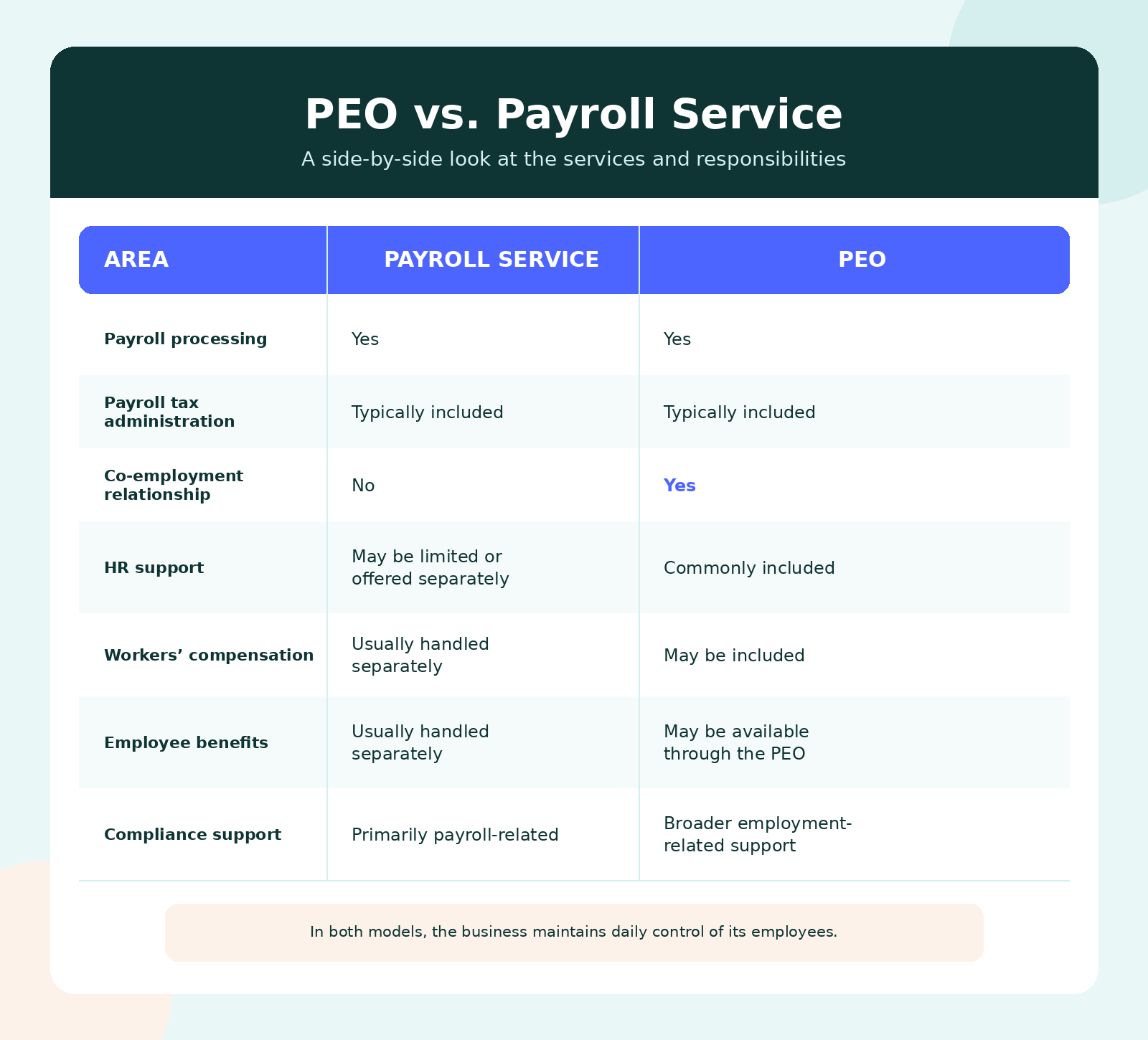
The exact services will vary by provider and contract, so businesses should review what is included rather than relying on the name of the service alone.
Does a PEO Take Control of Your Business?
This is one of the most common concerns business owners have about PEOs. The short answer is no.
A PEO does not step in and begin running your company. You continue making the decisions that shape the business, including whom you hire, how employees perform their jobs, what they are paid, and how your workplace operates.
The PEO handles the agreed-upon administrative responsibilities behind those decisions. Think of it less as handing over your business and more as adding experienced support for the parts of employment administration that can become complicated or time-consuming.
When Is a Payroll Service the Better Choice?
A stand-alone payroll service may be enough when a business already has a solid system for managing HR, insurance, employee benefits, and compliance. It can also make sense for a small employer with straightforward payroll needs and access to outside HR, legal, or insurance support when questions arise.
For example, imagine a small professional office with five employees, one work location, and an established benefits broker. The owner may only need help calculating wages, processing direct deposits, and managing payroll tax filings. In that case, a traditional payroll service may cover the immediate need without adding services the company is not ready to use.
However, payroll rarely stays simple forever. Hiring in another state, adding employee benefits, dealing with a workers’ compensation claim, or keeping up with changing employment requirements can quickly expand the workload.
When Does a PEO Make More Sense?
A PEO may be a stronger fit when payroll is only one piece of the problem.
Perhaps a construction company is trying to manage weekly payroll, employee time records, workers’ compensation, and frequent hiring at the same time. Maybe a growing office no longer has enough internal capacity to answer employee questions, update policies, and coordinate benefits. A business expanding into new locations may also need more guidance as its workforce obligations become more complex.
In those situations, using separate providers for every function can create its own administrative mess. Information has to move between the payroll company, insurance carrier, benefits provider, timekeeping platform, and whoever is handling HR. A PEO brings more of those responsibilities together within one working relationship.
A PEO may be worth considering if your business needs support with:
- Payroll processing and tax administration
- Workers’ compensation
- HR questions and documentation
- Employee benefits
- Time and attendance
- Workforce compliance
The real value is not simply having access to more services. It is having those services work together around the same workforce.
Is a PEO More Expensive Than a Payroll Service?
A PEO generally includes more services than a basic payroll provider, so comparing the two based only on the payroll fee will not tell the whole story.
Business owners should look at the total cost of managing payroll, HR, workers’ compensation, benefits administration, technology, and compliance. They should also consider the time spent communicating with several vendors or trying to solve employment issues internally.
A lower payroll fee may look appealing until the business still has to purchase insurance, manage HR tasks, and pay for separate workforce systems. On the other hand, a company that genuinely needs nothing beyond payroll processing may not benefit from paying for a wider service package.
Ask each provider for a clear explanation of what is included, what costs extra, and how pricing may change as your workforce grows.
Can You Switch From Payroll Services to a PEO Later?
A business can begin with payroll services and move into a PEO relationship as its workforce needs change.
The transition requires planning because payroll records, tax information, employee documents, insurance details, and benefit elections may need to move into a new system. Timing can also affect tax reporting and employee communications.
If you expect to grow soon, ask a prospective provider whether it offers both payroll services and PEO support. Having both options available can make it easier to expand your level of service without starting over with an entirely new company.
How Do You Choose Between a PEO and Payroll Service?
Start by looking beyond the paycheck. Payroll may be your most visible administrative task, but it is not always the source of the greatest pressure.
Consider where your team is spending time, which responsibilities are falling behind, and where mistakes could create the most serious consequences. If payroll processing is the only concern, a payroll service may be the right answer. If payroll is tangled up with HR, benefits, workers’ compensation, or compliance challenges, a PEO may provide more complete support.
Before choosing, ask:
- Which services are included in the quoted price?
- Will I have a consistent point of contact?
- Who handles payroll tax filings and notices?
- What HR support is available?
- How are workers’ compensation and benefits managed?
- Can the service support additional employees or locations?
- What responsibilities will remain with my business?
Clear answers now can prevent frustrating surprises later.
Find the Right Level of Payroll and HR Support
Choosing between a PEO and a payroll service is not about finding the option with the longest feature list. It is about identifying how much support your business truly needs.
Universal Select offers both payroll services and PEO solutions, giving businesses the flexibility to choose support that matches their workforce and stage of growth. From payroll processing and tax administration to workers’ compensation, HR outsourcing, benefits, and time tracking, our Jacksonville-based team helps employers spend less time untangling administrative work.
Contact Universal Select to discuss your business and determine whether payroll services or a PEO relationship is the better fit.
Frequently Asked Questions
1. Is a PEO the same as a payroll company?
No. A payroll company primarily processes employee pay and related taxes. A PEO includes payroll within a broader co-employment relationship that may also cover HR, workers’ compensation, benefits, and compliance support.
2. Do employees work for the PEO or the client company?
Under a PEO arrangement, the PEO and client share certain employer responsibilities. The client company continues directing employees’ daily work and making operational decisions.
3. Can a small business use a PEO?
Yes. Small and growing businesses often consider PEO services when they need broader workforce support but do not want to build a full internal HR department.
4. Does a PEO handle workers’ compensation?
Many PEO arrangements include workers’ compensation coverage and administration. The exact services and responsibilities depend on the provider and agreement.
5. Which is better, a PEO or payroll service?
Neither option is automatically better. A payroll service may suit a business that only needs help processing payroll, while a PEO may be more appropriate when the business also needs support with HR, benefits, workers’ compensation, and compliance.
Ready to Get Started?
Get a free quote and see how Universal Select can save you time and money.