

How Pay-As-You-Go Workers’ Compensation Works
Instead of relying heavily on projected annual payroll, premiums are calculated using current payroll information and collected throughout the year.

Traditional workers’ compensation billing can feel like paying for next year’s weather based on last year’s forecast. Your premium is calculated using an estimate of what you expect to pay employees, even though staffing levels, overtime, and job duties may change before the policy period ends.
Pay-as-you-go workers’ compensation takes a more practical approach. Instead of relying heavily on projected annual payroll, premiums are calculated using current payroll information and collected throughout the year. You still have workers’ compensation coverage, but the payment schedule follows the actual rhythm of your business more closely.
What Is Pay-As-You-Go Workers’ Compensation?
Pay-as-you-go workers’ compensation is a billing method that connects workers’ compensation premiums to payroll. Each time payroll is processed, the employer’s current wage information is used to calculate the workers’ compensation premium owed for that pay period.
With a traditional policy, an employer may pay a significant deposit at the beginning of the policy term. That amount is based on estimated annual payroll. At the end of the term, the insurance carrier reviews the company’s actual payroll and employee classifications through an audit.
Pay-as-you-go coverage does not eliminate the policy or necessarily remove the audit. It changes how the premium is calculated and collected during the year.
Pay-as-you-go workers’ compensation calculates premiums from current payroll data instead of depending primarily on an annual payroll estimate.
How Are Pay-As-You-Go Premiums Calculated?
Workers’ compensation premiums are generally influenced by three primary factors:
- The amount of payroll associated with covered employees
- The classification codes assigned to the work those employees perform
- The rate associated with each classification
Employees are grouped according to the type of work they do because different jobs carry different levels of risk. An office administrator, for example, would not typically have the same classification or rate as a roofer, warehouse employee, or construction worker.
As payroll is processed, wages are assigned to the appropriate classifications. The applicable rates are then used to calculate the premium for that payroll period.
Because the calculation uses recent payroll information, the amount paid can rise or fall as staffing and wages change.
How Does the Pay-As-You-Go Process Work?
The process is usually connected to the employer’s payroll system.
First, the business runs payroll as usual. The payroll data identifies employee wages and the workers’ compensation classifications connected to those employees. The premium is then calculated based on that information and collected according to the employer’s payroll schedule.
That might mean weekly, biweekly, semimonthly, or another schedule, depending on how often employees are paid.
The result is a series of smaller premium payments throughout the year instead of a larger upfront payment based on projected payroll.
What Happens When Payroll Changes?
This is where the pay-as-you-go model can become especially useful.
Imagine a landscaping company that employs a larger crew during spring and summer but reduces its workforce during slower months. With a traditional billing structure, the company may have to estimate that seasonal payroll before the policy begins. If the estimate is too low, it could face an additional balance after the year-end audit. If the estimate is too high, it may tie up cash while waiting for an adjustment or refund.
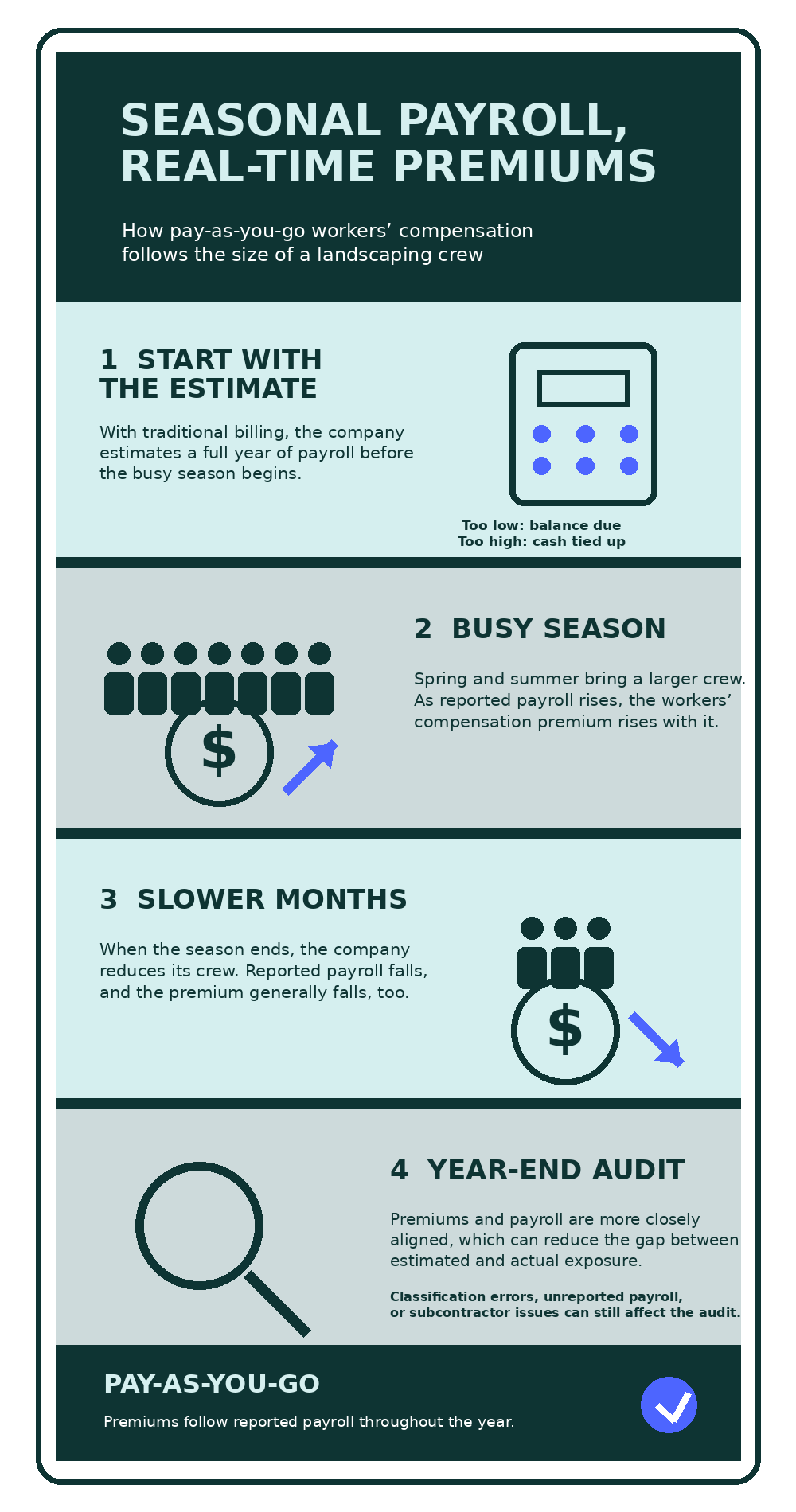
This does not mean every final adjustment disappears. Classification errors, unreported payroll, subcontractor issues, or other discrepancies can still affect an audit. However, using current payroll data can reduce the gap between estimated and actual exposure.
Does Pay-As-You-Go Workers’ Compensation Require a Large Deposit?
One of the reasons businesses consider pay-as-you-go coverage is the possibility of reducing the large upfront payment often associated with traditional workers’ compensation policies.
Exact deposit requirements depend on the carrier, policy, and employer. Pay-as-you-go should not automatically be interpreted as “no deposit,” but it may allow a business to begin coverage with less money due upfront.
That difference can matter for a growing company that needs to preserve cash for inventory, equipment, hiring, or everyday operating costs. Instead of committing a substantial amount based on projected annual payroll, the business pays premiums incrementally as wages are reported.
Does Pay-As-You-Go Eliminate Workers’ Compensation Audits?
Not necessarily. A pay-as-you-go plan can make an audit more predictable, but it does not guarantee that no adjustment will be needed.
An audit may review payroll records, job classifications, employee duties, overtime, payments to owners, and the use of contractors or subcontractors. If an employee was assigned to the wrong classification or payroll was reported incorrectly, the final premium may still change.
The advantage is that premiums have already been based on ongoing payroll data. When the information is accurate and classifications are kept current, there may be a smaller difference between what the business paid during the year and what it ultimately owed.
Good records still matter. Businesses should review employee roles as they change and report new hires, terminations, and payroll adjustments promptly.
What Are the Benefits of Pay-As-You-Go Workers’ Compensation?
The main benefit is not simply making smaller payments. It is aligning insurance costs more closely with what is happening inside the business.
Pay-as-you-go workers’ compensation can offer:
- Improved cash flow by spreading payments across payroll periods
- Premiums based on current payroll instead of a year-long projection
- Smaller differences between estimated and actual payroll
- Less manual reporting when payroll and workers’ compensation are connected
- Greater visibility into workers’ compensation costs throughout the year
These advantages can be particularly helpful for seasonal businesses, companies with fluctuating staffing levels, and employers experiencing steady growth.
Are There Any Drawbacks?
Pay-as-you-go workers’ compensation depends on accurate payroll information. If an employee is assigned to the wrong classification or payroll data is incomplete, the premium may still be calculated incorrectly.
Businesses also need to remember that pay-as-you-go is a payment method, not a replacement for workplace safety or claims management. Employers remain responsible for maintaining a safe workplace, reporting injuries, keeping required records, and following applicable workers’ compensation rules. OSHA outlines employers’ broader responsibilities for workplace safety and recordkeeping.
The system works best when payroll records, employee classifications, and insurance information stay aligned.
Which Businesses Benefit Most From Pay-As-You-Go Coverage?
Pay-as-you-go workers’ compensation can work for many types of employers, but it may be especially useful for businesses with payroll that changes throughout the year.
A restaurant may add staff for a busy season. A contractor may hire additional workers after winning a large project. A new company may grow faster than expected, while another business may reduce hours during a slower period.
In each case, estimating an entire year of payroll can be difficult. Connecting premiums to current payroll allows insurance costs to respond as the workforce changes.
Even businesses with stable payroll may appreciate the more predictable payment schedule and reduced dependence on annual estimates.
What Should You Ask Before Choosing a Pay-As-You-Go Plan?
Not every program is structured the same way. Before enrolling, ask the provider:
- How often will premiums be calculated and collected?
- Is an initial deposit required?
- Are payroll and workers’ compensation connected in one system?
- How are new hires and classification changes reported?
- Will the policy still require an annual audit?
- Are there setup, reporting, or cancellation fees?
- Who can help if a payroll or classification issue appears?
You should also confirm which responsibilities belong to the payroll provider, insurance carrier, PEO, and your business. A clear process makes it easier to correct problems before they become expensive surprises.
Make Workers’ Compensation Fit the Way You Pay Employees
Workers’ compensation is a necessary cost of employing people, but the bill does not have to be based on a guess made months earlier. Pay-as-you-go coverage connects premiums to payroll, giving businesses a payment structure that better reflects their current workforce.
Universal Select combines pay-as-you-go workers’ compensation with payroll and HR support, helping Florida businesses manage connected responsibilities in one place. Our Jacksonville-based team works with companies throughout Duval, Nassau, St. Johns, and Clay counties, with support built around real people rather than an impersonal call center.
Contact Universal Select to learn how pay-as-you-go workers’ compensation could work for your business.
Frequently Asked Questions
1. Is pay-as-you-go workers’ compensation a different type of insurance?
No. It is primarily a different way of calculating and collecting the premium. The business still has a workers’ compensation insurance policy, subject to its terms and coverage requirements.
2. Are workers’ compensation premiums deducted from employees’ paychecks?
Generally, workers’ compensation premiums are an employer expense rather than a deduction taken from employee wages. Employers should follow the rules that apply in their state and consult their provider with specific questions.
3. Can pay-as-you-go premiums change every pay period?
Yes. Because premiums are based on reported payroll, the amount may change when employee wages, hours, staffing levels, or classifications change.
4. Will pay-as-you-go prevent an audit bill?
It may reduce large discrepancies by using current payroll data, but it cannot guarantee that no additional premium will be due. Incorrect classifications, missing payroll, and other reporting issues can still lead to an adjustment.
5. Can small businesses use pay-as-you-go workers’ compensation?
Yes. Small businesses may find the model helpful because it can reduce dependence on a large estimated payment and spread workers’ compensation costs across regular payroll periods.
Ready to Get Started?
Get a free quote and see how Universal Select can save you time and money.